
How to Check Criminal History in Denton County
The Denton County Judicial and Law Enforcement Records Search hub is the best first routing point. It connects to case, calendar, jail, bond, conviction, registry, and wanted-person resources, but those links do not all search the same records. Start with the event you need to confirm. A filed charge belongs in a clerk's case index. A recent custody event belongs in a jail search. A statewide public conviction result comes from Texas DPS.
Gather a full legal name, date of birth, spelling variants, a rough date range, and a cause or booking number if one is known. A common name alone is weak proof of identity. Denton County warns that online entries depend on data input and that the actual clerk file controls. Use these steps to move from a broad result to the original record:
- Choose the case, jail, or bond tab that matches the event, rather than searching every Denton County record as though it were one file.
- Enter the narrowest reliable criteria. An exact cause or booking number is stronger than a name-only match.
- Compare dates, court, arresting agency, charge, and status before deciding that a result belongs to the right person.
- Open the detail and note the custodian. Court pleadings come from the clerk, while an incident narrative stays with the arresting agency.
- Request a certified disposition or fingerprint-based personal review when an index entry is not enough.
For the full court-file process, use the Denton County criminal court case records route after the initial search.
Denton County Records: Four Systems
Denton County Records places several search tabs behind one public interface. That convenience can hide a key distinction. The case tab indexes a clerk-managed prosecution, the calendar tab tracks scheduled proceedings, the jail tab reports custody, and the bond tab reflects release security. A person may appear in one area but not another. A new booking can exist before prosecutors file a case, and a released person can still have an open prosecution.
The official county hub shows how those products are grouped.
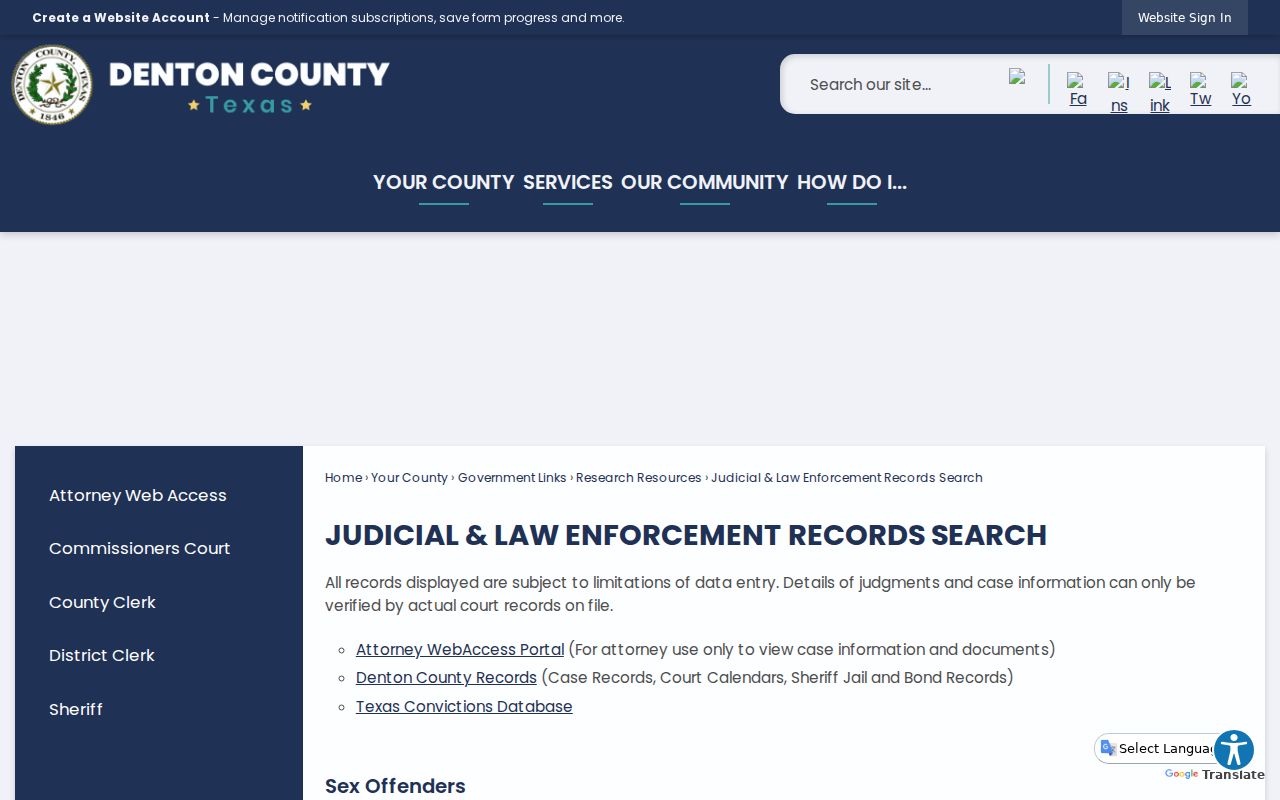
The screen is a directory, not a promise that every Denton County criminal record is complete or current. The county says actual court records should verify judgments and case information.
| Search field | Use | Best practice |
|---|---|---|
| Search type | Case, calendar, jail, or bond | Pick the record created by the event |
| Name | Broad identity search | Add first, middle, and birth details when available |
| Case number | Exact court file | Use the complete local cause number |
| Filed date range | Narrows court results | Allow for a gap between arrest and filing |
| Court | Limits the docket | Select it only when the court level is known |
Official Texas Background Checks
The Texas Department of Public Safety Crime Records Service keeps the central state repository. Its public Criminal History Name Search is a paid, identity-by-name product focused on public convictions and deferred adjudications, with associated reportable arrests. It is not a complete rap sheet. It also does not replace a Denton County docket search because a local pending or dismissed case may fall outside the public DPS result.
A member of the public creates an account, prepays search credits, and searches the DPS Criminal History Name Search. Each credit is $3, with card or convenience charges possible. Exact birth data helps, but only fingerprints establish identity with the same strength as a subject record review. Compare any candidate with the Denton County court file.
| Official product | Identity method | Scope | Published fee |
|---|---|---|---|
| DPS public name search | Name and birth filters | Authorized public Texas conviction and deferred data | $3 per credit; added card charges may apply |
| DPS personal record review | Fingerprints | The subject's Texas criminal history | Current fee shown during FAST enrollment |
| FBI Identity History Summary | Fingerprints | FBI-maintained identity history | $18 for a direct FBI request |
| Denton County court search | Name or cause number | Local docket and available file material | Search is free; copies and certification may cost |
Denton County Fingerprint Record Review
Fingerprint review is the sound route for checking your own Texas record or challenging an identity error. Texas Fingerprint Applicant Services of Texas uses IdentoGO by IDEMIA. The authorizing agency supplies the service code, so no universal code should be guessed. Enrollment sites and times can change. Search by a current Denton-area ZIP during booking and bring the identification listed for that service.
The official FAST enrollment page shows the appointment path used for a Denton County fingerprint record review.
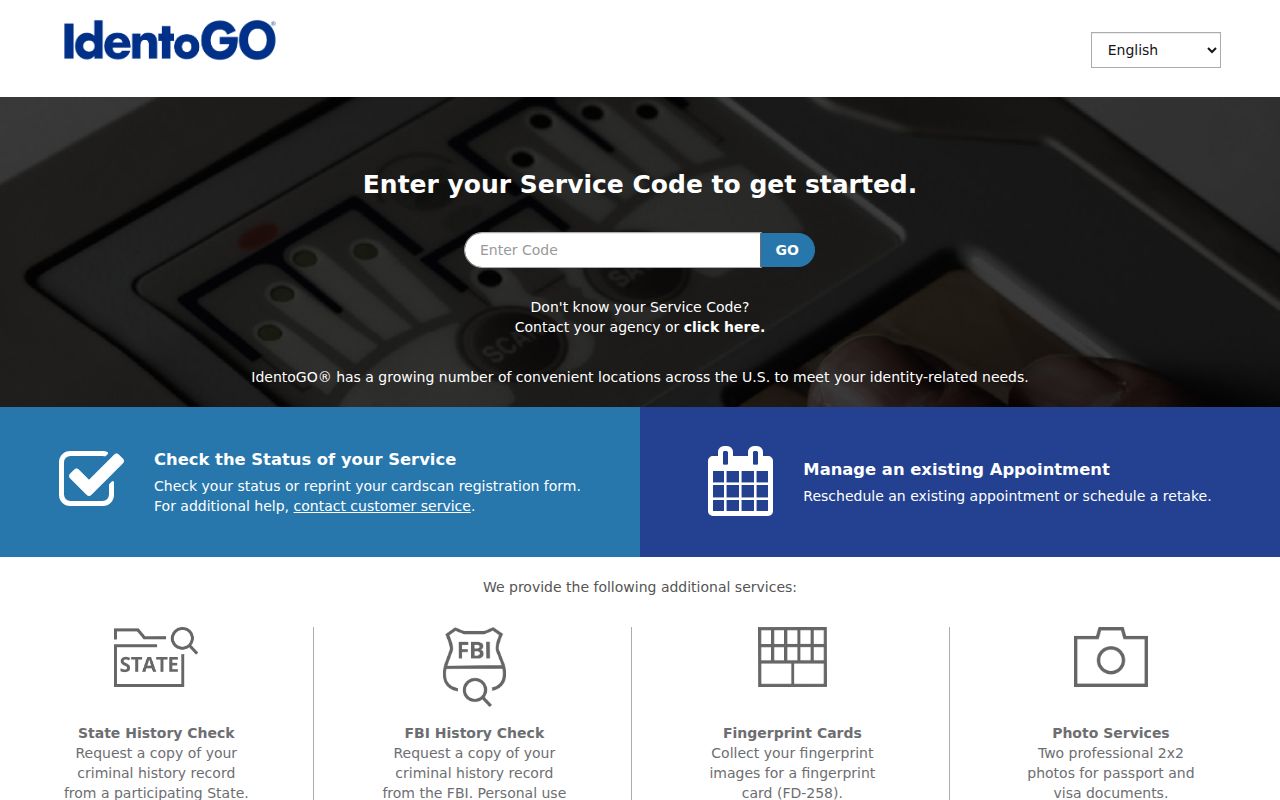
Results should be compared with a certified Denton County disposition. If a cycle is wrong, identify the SID or transaction control number when shown, the reporting agency, the cause number, and the correct disposition. A source error may need correction at both the clerk or arresting agency and DPS.
DCSO also takes public ink fingerprint cards at 127 N. Woodrow Lane on Tuesdays and Thursdays from 1 to 3 p.m., excluding holidays. The cited county source does not state a current card fee, so call the sheriff before visiting.
Types of Criminal Records
Denton County criminal history is a chain of records, not a single document. The first officer creates an incident or arrest report. A jail makes a booking file. A magistrate records probable cause and bail. Prosecutors decide what to file, then a clerk maintains the court case and reports its result. DPS links fingerprint-supported arrest cycles with later disposition data.
Knowing who made each item prevents a request from reaching the wrong office:
- Arrest and incident reports: the sheriff, city police, campus police, constable, or state agency that handled the event keeps the narrative.
- Booking records: DCSO or a city jail records intake, initial charges, bond, and release status.
- Criminal case files: the District Clerk keeps felony and magistrate filings, while county, municipal, and justice courts keep matters within their level.
- Warrants: the issuing court and serving sheriff, police, or constable may each hold part of the record.
- State records: DPS keeps reportable criminal history, TDCJ keeps prison and parole information, and DPS runs the public sex offender registry.
Restricted juvenile, victim, sealed, expunged, and nondisclosed material does not follow ordinary public access rules.
Denton County Record Offices by Campus
The main clerk counter and the sheriff campus are separate. The Denton County Courts Building at 1450 E. McKinney Street holds the District Clerk on the first floor. That office is the custodian for felony and magistrate filings and is open Monday through Friday from 8 a.m. to 4:30 p.m. The Law Enforcement Center at 127 N. Woodrow Lane holds DCSO records and jail functions. It is the right campus for a sheriff report or county booking record.
The District Clerk page identifies the modern court records destination.
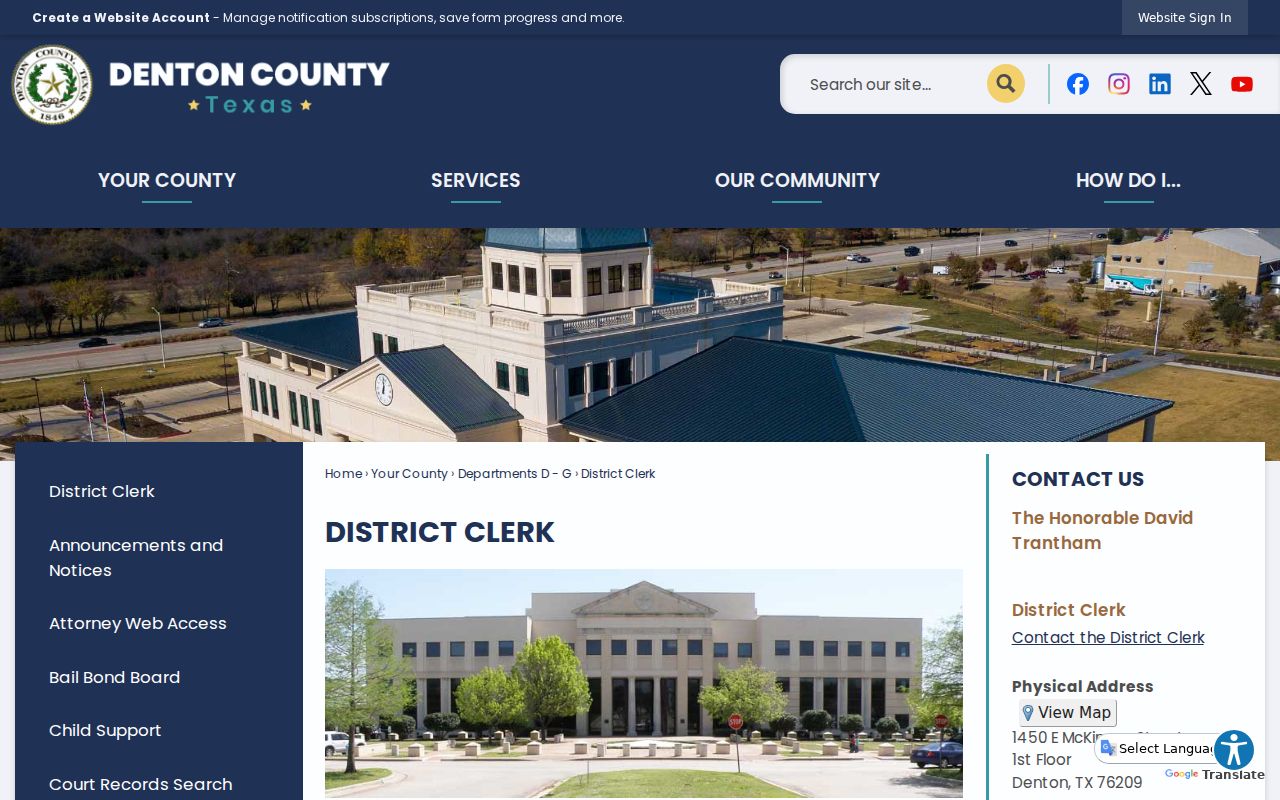
The image helps distinguish the operating records site from the historic Courthouse-on-the-Square at 110 W. Hickory Street. The old courthouse is a museum and civic landmark, not the main criminal-record counter.
District Clerk
1450 E. McKinney St., 1st Floor
Denton, TX 76209
940-349-2200
Weekdays, 8 a.m. to 4:30 p.m.
DCSO Records Division
127 N. Woodrow Lane
Denton, TX 76205
940-349-1630
Mail, email, hand delivery, or GovQA
What a Denton County Criminal Record Shows
The contents depend on which Denton County record is open. A booking profile reports intake and custody. A court file follows a prosecution. A DPS entry connects reportable arrest cycles with submitted outcomes. Read the label before reading the facts, since an initial jail charge can change or never be filed.
| Name and identifiers | Legal name, aliases, birth details, booking number, cause number, or state identifiers where release is authorized. |
|---|---|
| Arrest and booking | Arresting agency, intake time, initial allegation, bond type and amount, and custody or release status. |
| Charges and statutes | Filed offense, legal citation, degree or class, and later amendments shown in the clerk file. |
| Disposition | Pending, dismissed, acquitted, deferred, convicted, or another recorded outcome for each filed count. |
| Sentence | Jail or prison term, fine, costs, restitution, or community supervision when ordered. |
| Custody or supervision | Selected jail, TDCJ, probation, parole, and release facts, not confidential case-management notes. |
- Disposition
- The final or present outcome assigned to a charge or case.
- Docket
- The clerk's chronological list of filings, hearings, and court actions.
- Deferred adjudication
- A Texas result in which final conviction is held back while court-ordered supervision is completed.
- Capias
- A court order directing an arrest, often after a missed court duty.
Denton County Jail Records and Contact
The DCSO jail search is for current or recent county custody. It may show a booking number, intake time, arresting agency, charge description, case or warrant reference, bond, facility, and release status. It does not prove guilt. Medical information, housing-cell placement, and safety classifications are private, and the public configuration does not promise a booking photograph in every result.
Call jail information at 940-349-1700 for current custody or jail records at 940-349-1630 for a record question. A recent Lewisville arrest may first appear in that city's municipal jail. A sentenced state prisoner belongs in the TDCJ Online Inmate Search, not the county roster.
Denton County uses HomeWAV for all visits. Public on-site video visits run Saturday from 8 a.m. to 7:30 p.m.; remote visits run daily from 7:30 a.m. to 9 p.m., subject to approval. Ordinary mail is sent to Smart Communications in Seminole, Florida, for scanning, while legal mail still goes to Woodrow Lane. These services concern contact with a person in custody, not the public release of a criminal history.
Public Access Laws
The Texas Public Information Act generally allows a person to request existing government records, but it does not make every law-enforcement detail public. A custodian may redact protected identifiers, victim data, confidential juvenile material, or information covered by an active-investigation exception. Court files also follow judicial record rules and the clerk's access process. DPS criminal history has its own dissemination limits.
Key Texas authorities:
Government Code Chapter 552 provides the public-record request framework and law-enforcement exceptions.
Government Code Sections 411.083 through 411.087 limit criminal-history dissemination and define the public subset.
Code of Criminal Procedure Chapter 55A controls eligibility and procedure for expunction.
Code of Criminal Procedure Chapter 62 governs sex offender registration and public registry information.
DCSO accepts requests by mail, email at so.orr@dentoncounty.gov, written hand delivery, or its linked GovQA portal. A precise request names the incident, date, place, agency, and desired format. The office must produce existing records, not answer questions or create a custom compilation.
Denton County Warrant Record Routes
A Denton County warrant search starts with the issuing court, not a supposed statewide list. Texas has no comprehensive public active-warrant portal. The county's warrant information page explains that citations written by troopers, game wardens, and county deputies may remain with a justice court. A judge may issue a warrant after a person fails to resolve the citation, and the constable serves it.
Search the underlying case in Denton County Records, then confirm status with the issuing justice, municipal, county, or district court. DCSO's warrant line is 940-349-1560. Public indexes may lag, and sealed warrants will not appear. Do not go to the jail merely because an online entry seems current. Confirm the cause number, bond or payment method, and written clearance with the court or counsel.
An arrest warrant rests on probable cause. A bench warrant or capias often follows a missed duty in a case. A capias pro fine follows judgment in a fine-only case. Each is resolved through the court that issued it.
Sealed, Expunged & Restricted
Expunction and nondisclosure have different effects in Texas. A qualifying Chapter 55A expunction directs listed agencies to remove or destroy covered records. An order of nondisclosure keeps the record but limits ordinary public disclosure while preserving access for agencies and other entities named by law. The word “dismissed” does not establish eligibility for either remedy.
Start with the whole Denton County arrest episode and obtain certified dispositions. The District Clerk publishes expunction materials, an agency contact sheet, and an issuance request for certified mail. Eligibility and filing cost depend on the result, timing, related charges, and number of agencies served. The exact total must come from the current clerk calculation, not an estimate.
Denton Municipal Court has a separate form for qualifying dismissed or acquitted Class C matters. Juvenile records, victim identities, medical facts, financial numbers, and active-investigation material may also be sealed, confidential, or redacted for reasons unrelated to expunction.
Denton County Probation and Parole Records
Denton County Community Supervision and Corrections Department manages adult probation-style supervision ordered by local courts. The public case docket may show that community supervision was imposed, a later motion to revoke, or a new judgment. It will not expose confidential officer notes, treatment records, or the full supervision file. Confirm the public sentence with the court and route program questions to CSCD.
Parole is different. The Texas Board of Pardons and Paroles makes release decisions, while the TDCJ Parole Division supervises people after release. The Denton District Parole Office is at 1117 Teasley Lane and can be reached at 940-566-1116. TDCJ's locator shows selected incarceration and release facts. The Integrated Victim Services System also supports custody and parole status searches and notifications.
A probation violation may create a motion in the Denton County sentencing court. A parole violation follows the state revocation process. Search the court docket for the first and TDCJ or IVSS for the second.
Criminal Records by City in Denton County
City police departments create their own incident reports, and municipal courts keep their own Class C citation files. Denton, Carrollton, and Lewisville therefore add local routes to the county system. Denton sends police public-information requests through the City Secretary. Lewisville maintains a police records window and a municipal jail. Carrollton spans three counties, so the incident and court location must be identified before a county search.
Denton Criminal History
Population estimate 169,431 · City Secretary records route and Denton Municipal Court
Carrollton Criminal History
Citywide estimate 135,456 · Three-county routing and city citation records
Lewisville Criminal History
Population estimate 133,553 · Police report, city jail, and municipal warrant channels
Denton County Judicial Record Limits
The broad county hub is useful because it places case records, calendars, jail and bond searches, DPS conviction data, registry links, most-wanted resources, Crime Stoppers, and custody notifications in one official directory. Its own warning is just as useful. Online display is limited by data entry, and only the record held by the clerk can verify a judgment.
Reporting time explains many apparent conflicts. A booking starts at the jail, a charging document begins with the prosecutor and clerk, and a disposition later moves to DPS. Missing fingerprints, a name variation, or an unreported result can break that chain. Compare the arresting agency report, Denton County clerk file, and DPS personal record review before asking an office to correct data.
Federal cases are outside this chain. Denton County lies in the Eastern District of Texas, whose filings use PACER. Federal custody uses the Bureau of Prisons locator, while state prison custody uses TDCJ and pretrial county custody uses DCSO.