
Running a Sex Offender Check in Denton County
The Texas Public Sex Offender Registry is the main public search for Denton County. Texas DPS manages the statewide database, while local law enforcement registers people and checks the facts they must report under Chapter 62. Search statewide first. A county filter gathers Denton County results, a city filter narrows the list, and an address search helps with nearby locations. When a match matters, open the full live profile instead of relying on a list view or an old saved copy.
Denton County's Judicial and Law Enforcement Records Search hub adds local routes for Carrollton, The Colony, Denton, Flower Mound, Highland Village, Lake Dallas, Lewisville, and unincorporated Denton County. Those links matter because city police may be the registration authority inside municipal limits, while DCSO handles the unincorporated area. Begin with a legal name or a precise address. Use aliases, physical details, and the registering agency to distinguish people with similar names.
The statewide and local channels answer different parts of the same question. DPS supplies the public profile and statewide search fields. The county hub helps identify the local office tied to a Denton County location. A city list can be helpful for local routing, but it should not be treated as faster, fuller, or more current than the live state profile unless that agency expressly says so. If the results differ, note the date of each search and ask the registering authority to verify the current public facts.
Prepare the search before opening either channel. Write down the known spelling, any alias, and the exact Denton County place that prompted the check. Decide whether the aim is to identify one profile or review an area. That choice determines whether name mode or geography mode is more useful. Do not add unrelated personal details merely to force a match. When several candidates remain, compare only the public identifiers on the DPS profiles and contact the listed agency if a safety concern cannot be resolved from the official display.
Denton County's Eight Registry Routes
The county hub reflects how local government is split across Denton County. It does not create eight separate statewide registries. Instead, it sends readers to the local list or agency serving each place. Carrollton needs extra care because the city crosses Denton, Dallas, and Collin counties. For an unincorporated address, contact the Denton County Sheriff's Office at 127 N. Woodrow Lane, Denton, TX 76205, or call 940-349-1600. The county's sheriff services directory also routes registry and records resources. Within a city, contact that police department's registration authority. Exact DCSO registration-unit hours and fees were not published, so confirm them before visiting.
The official Texas registry search form shows the fields used for a Denton County check.
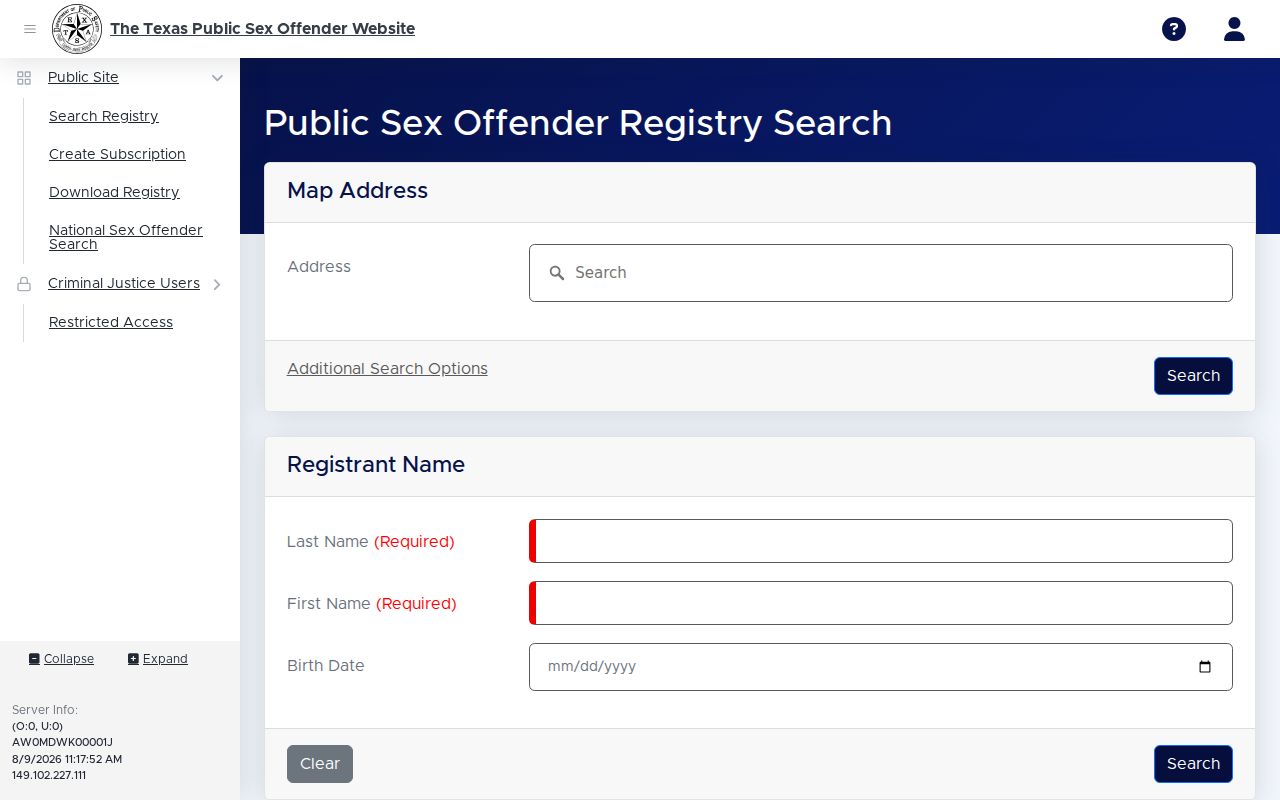
That form lets a reader move between name and place-based searches instead of treating one field as a complete identity check.
The eight routes prevent a common Denton County error: calling DCSO about every address within the county line. Denton, Lewisville, Flower Mound, The Colony, Highland Village, Lake Dallas, and Carrollton addresses may route to city police, while an unincorporated address points to the sheriff. Copy the registering agency from the live DPS profile before calling. That agency can change after a move, which is why the hub works best as a directory and the profile supplies the record-specific office. Do not assume a records counter and registration unit share hours; confirm appointment instructions by phone.
Searching the Texas Public Sex Offender Registry
Texas DPS offers name and geographic search modes in the Texas Public Sex Offender Registry. One mode is enough to begin. A known name is useful for locating a specific profile. An address, ZIP, city, or Denton County filter works better for community awareness near a place. The portal controls partial-name behavior and the exact radius choices, so use the options shown on the live form rather than assuming a fixed distance.
- Open the DPS registry and choose name or address/geography mode.
- Enter the known name, or select Denton County and add a city, ZIP code, or street address to narrow the area.
- Review the list or map, then compare aliases, physical traits, and the registering agency before selecting a record.
- Open the full profile and read the address, status, offense, risk information, and verification details shown there.
| Field Label | Type | Required | Notes |
|---|---|---|---|
| Search by | Tabs or mode | One mode | Name, address/geography, or institute of higher education when offered |
| Last Name | Text | Name mode | Portal controls surname and partial-name behavior |
| First Name | Text | No | Narrows a surname search |
| Address | Text | Geography mode | Use a street address for a nearby search |
| City / County / ZIP | Text or select | No | Choose Denton County or a local city; ZIP uses five digits |
| Radius | Select | Address mode | Use the distances currently offered by the portal |
| Map / List | View control | No | Changes the display where enabled |
A broad county search can produce many entries, so narrow with facts that do not depend on guesswork. Add a first name to a surname search or shift to an address mode when the location is the point of concern. A map marker is not enough to confirm identity. Open the profile and compare the legal name, aliases, date-of-birth display, photograph, descriptors, and registering agency. Denton County readers should also check whether the displayed place is a residence, workplace, school, or another public field before interpreting the map.
Search results are a public snapshot rather than a guarantee about a person's present location. Texas registration data is reported and checked under statutory cycles, and a move can create a gap between an event and its display. Save no more personal detail than the lawful safety need requires. For later review, retain the official page link and search time instead of reposting a profile. That makes it easier to return to the current Denton County result and avoids spreading a stale address.
Cross-State Registry Searches from Denton County
A Denton County address search cannot show every registry record outside Texas. When a safety check crosses state lines, use the U.S. Department of Justice's National Sex Offender Public Website. NSOPW searches participating jurisdictions through one federal starting point. It is a supplement, not a replacement for the Texas profile. Follow a result back to its source registry and read the current jurisdiction's terms, status, and public fields.
The official NSOPW search illustrates the national layer available to Denton County readers.
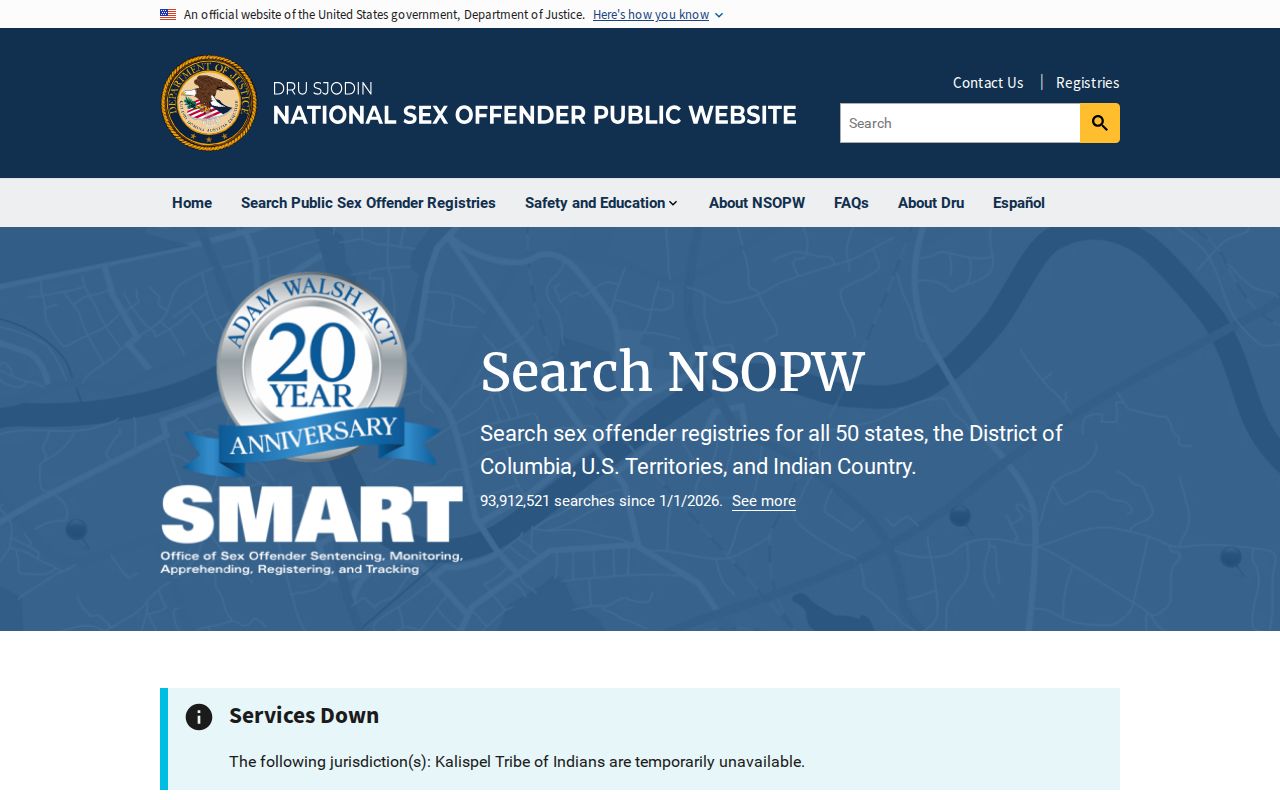
Using both systems helps when an address history or move reaches beyond Texas, while the state profile remains authoritative for Texas registration details.
Do not infer that a missing result proves there is no duty or record. Names change, jurisdictions publish different fields, and a search can fail because of spelling or a narrow place filter. Try a broader name search, then contact the proper agency when a public-safety concern depends on current registration. NSOPW is useful when a move reaches beyond Denton County, but the source jurisdiction still controls the record. A risk term used elsewhere may not mean the same thing as a Texas risk level. Open a Texas match at DPS and an out-of-state match at that state's official registry. Emergencies belong with 911.
What a Registry Profile Shows
A public DPS profile combines identity markers, reported location, registration facts, and the qualifying offense information Texas law permits the public to see. Field availability varies. A current photograph and physical marks can help separate similar names, while aliases and registry identifiers provide more checks. The address is reported and verified on statutory cycles, so it may change between visits. Private investigative notes, Social Security numbers, and other protected data are not part of the public view.
| Name & Aliases | Legal name and alternate names published for identity matching |
|---|---|
| Photo & Physical Description | Current photograph when available, sex, race, age or date of birth, build, and scars, marks, or tattoos |
| Reported Address | Residence or other published location and map information |
| Offense & Statute | Offense description, law, conviction or adjudication date, and jurisdiction |
| Risk Information | Texas risk level when assigned; it is not a federal tier label |
| Registration Status | Status, registering agency, and verification requirements shown for that record |
| Other Public Facts | Registry or SID identifiers, vehicles, workplace, school, and victim category when law permits |
The DPS profile layout shows how these facts are arranged without relying on a copied or saved private person's record.
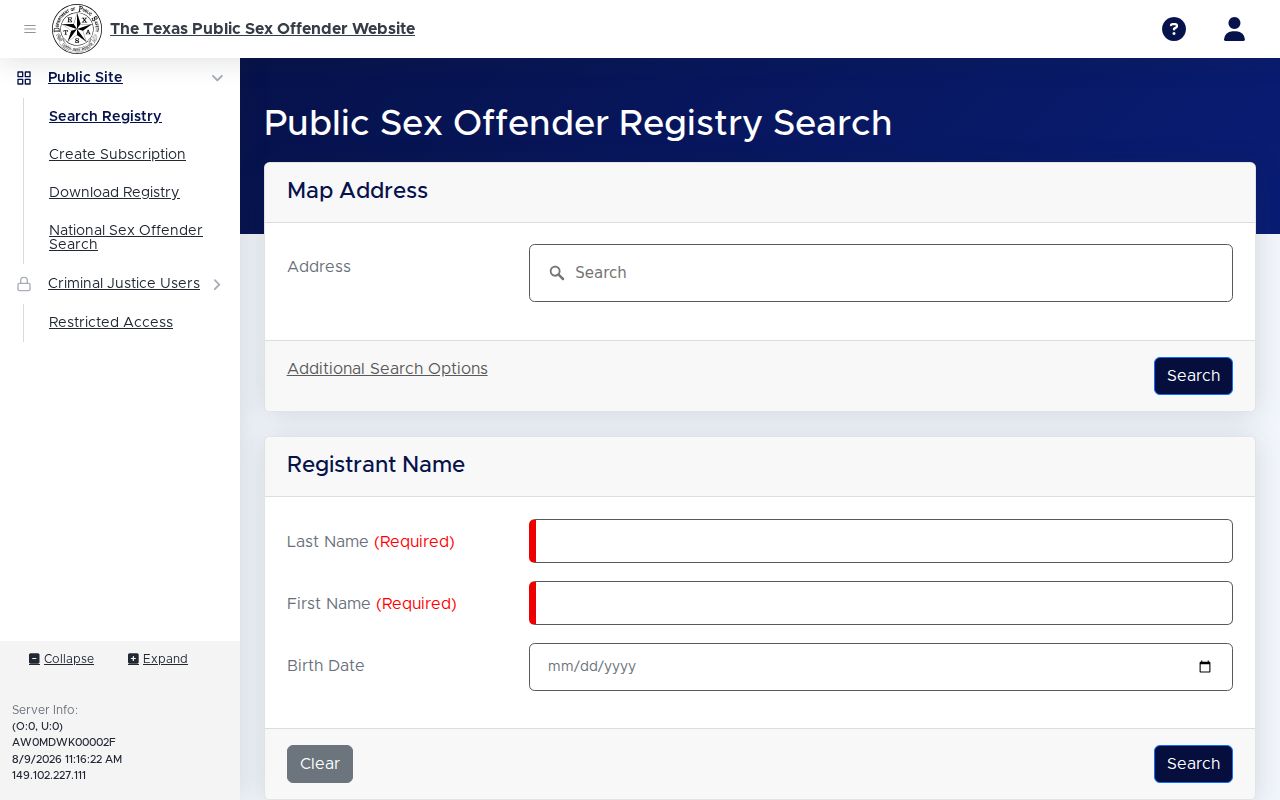
The layout makes identity, registration, and offense fields distinct, which reduces the risk of reading one fact as if it answered every question.
Offense and status fields require the same care. The listed offense identifies the reportable basis made public, but it does not reproduce the full Denton County court file. A conviction date is not a move date or last verification. Victim information is limited and should not be used to identify a person, while vehicle, work, or school data may appear on some profiles and not others. Protected identifiers and private investigative material stay outside the public profile. That is a legal boundary, not a missing-search problem. Use official identifiers and the registering agency to clarify a suspected mismatch, and use the proper court for a separate disposition question.
Denton County Risk Labels Explained
Texas risk levels describe an assessment of danger to the community. They do not work as a simple federal SORNA tier printed on each profile. Risk Level 1 means the screening tool indicates low danger, Level 2 means moderate danger, and Level 3 means high danger. A civil commitment designation is a separate legal status for a person found to meet the rules for a sexually violent predator. It should not be treated as another name for Risk Level 3.
Risk and registration length answer different questions. The duty may last ten years or for life based on the reportable offense, the release or supervision endpoint, and repeat-event rules in Chapter 62. A profile's risk label alone does not calculate the end date. For a specific duty, read the current statute and confirm the record with DPS or the local registration authority rather than doing calendar math from a general label.
Community-notification consequences can be greater for a high assessed risk, but no reader should assign a level that the profile does not show. The Texas table is descriptive. It does not permit a Denton County searcher to infer danger from an address, photo, offense label, or duration alone. Civil commitment also follows a separate legal process. Keeping these concepts apart supports sound safety planning and leaves assessment, enforcement, and registration decisions with the agencies authorized to make them.
Note: Texas risk level, registration duration, and local verification duty are related fields, but none can safely substitute for the others.
Registration Requirements and Levels in Texas
Texas Code of Criminal Procedure Chapter 62 controls reportable offenses, public registry content, verification, duration, and local registration duties. Verification frequency depends on the statutory classification and status. The official Denton County sources reviewed do not publish one schedule that applies to every person, so the table does not invent a frequency. Use the live profile and ask the registering agency for the duty tied to the actual record.
| Texas concept | Duration or meaning | Verification |
|---|---|---|
| Risk Level 1 | Low assessed danger; not a duration category | Depends on Chapter 62 classification and status |
| Risk Level 2 | Moderate assessed danger; not a duration category | Depends on Chapter 62 classification and status |
| Risk Level 3 | High assessed danger; notice effects may be greater | Depends on Chapter 62 classification and status |
| Ten-year duty | Ten years after the later statutory release or supervision endpoint for covered offenses | Use the duty shown and confirm with the registration authority |
| Lifetime duty | Life for enumerated convictions or adjudications and qualifying repeat events | Use the duty shown and confirm with the registration authority |
| Civil commitment | Separate legal designation, not automatically Risk Level 3 | Controlled by the person's legal status and registration rules |
Denton County readers should not translate these rows into a personal deadline. Offense and repeat-event rules control, and the start point may depend on release or supervision. A local agency can confirm where a person reports, while DPS can address the statewide public profile.
The research did not establish one DCSO office schedule or fee that governs every registration visit. It also did not document a sheriff app with an app-only registry alert. Denton County readers should therefore call the responsible registration office for its current appointment process instead of relying on a guessed schedule or an unofficial alert service. Where the live DPS or local page offers a notice feature, follow only the options currently displayed. A countywide search can always be rerun at the official portal.
When a Denton County Address Changes
A printed result or browser capture freezes facts at one point in time. If a registered address appears wrong or has changed, return to the live DPS profile first. Check the current reported residence, registering agency, status, and verification fields. Then identify which office has authority. DCSO serves the unincorporated county area; a city police department may handle an address within its limits. Carrollton's three-county footprint makes the exact location especially important.
Report suspected noncompliance to the local registration authority or law enforcement. Give the location and the reason for concern, but do not confront a listed person or household. DCSO's main line is 940-349-1600 for unincorporated Denton County routing. For a city address, use the proper police department. Emergencies go to 911. The agency, not a member of the public, determines whether facts show a breach of a registration duty.
A useful report is factual and concise. State the Denton County location, when the concern was observed, and which live profile was checked. Avoid claims about intent or legal status. The local office can compare that information with nonpublic verification material and decide whether follow-up is needed. The county records hub is the fallback for finding the right city link. If the location sits near a city or county boundary, give the full address so dispatch or records staff can route it correctly.
Note: A stale address can reflect timing, reporting, or display issues, so the live profile and local authority should be checked before any conclusion.
Denton County Registry Versus Custody
A registry profile does not establish current jail or prison custody. It describes a public registration record. Someone sentenced to a Texas prison may be found through the TDCJ Online Inmate Search, while current or recent Denton County jail custody belongs in the county jail system. These databases have different custodians, purposes, and update paths. A missing custody match does not erase a registry duty, and a prison match does not replace the profile.
The official TDCJ inmate locator is the state-prison channel assigned to this comparison.
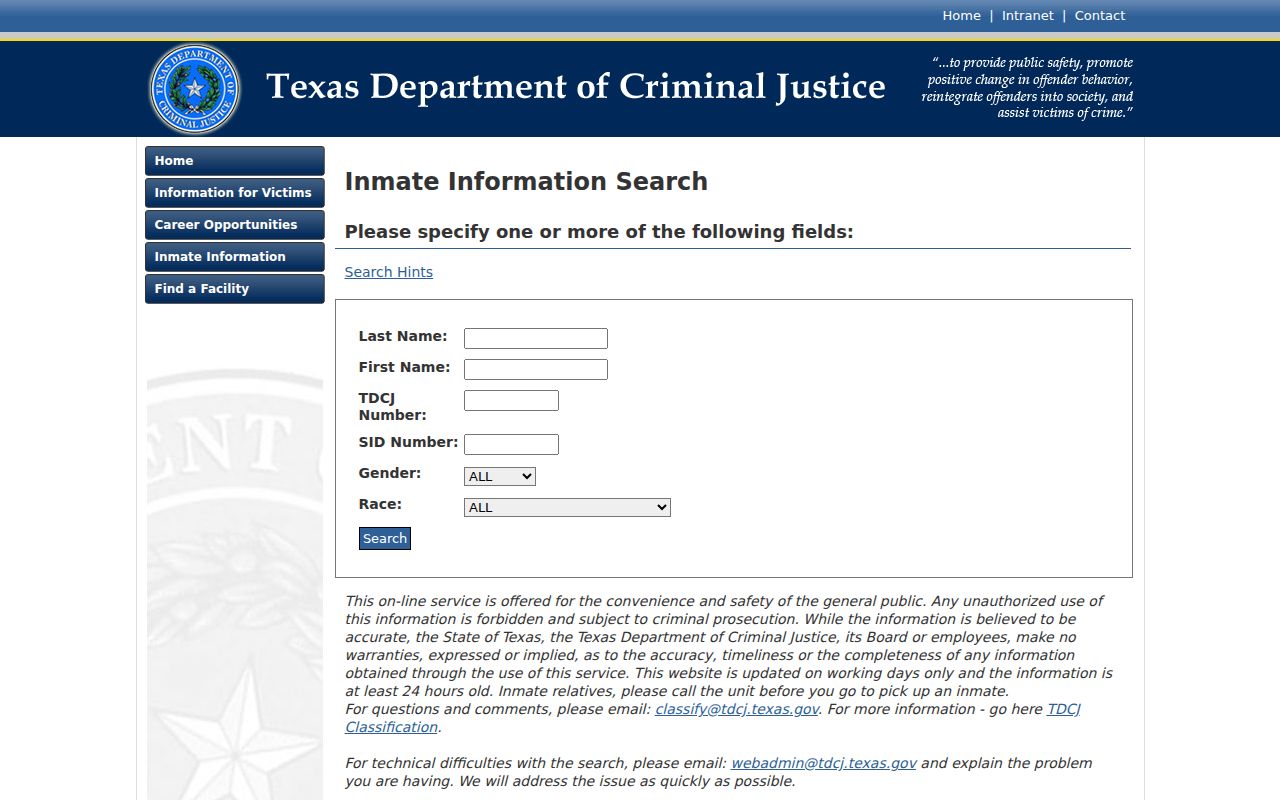
Keeping custody and registration searches separate prevents a state-prison status from being mistaken for a full registry record or local address check.
Current county custody is another distinct layer. The Denton County jail system covers present or recent county detention, while TDCJ covers sentenced state prisoners after transfer. Registration can still involve duties connected to release or supervision, but the public registry is the place to read the published duty and status. This separation also explains why the same name may appear with different dates or agencies. Compare identifiers and ask the responsible custodian to resolve a material conflict.
Lawful Use and Community Notification
Registry information is published for public safety and community awareness. It can support a family safety plan, help a resident understand a nearby result, or provide facts to share with law enforcement. Community notification and the public effect of a risk assessment depend on Texas law and the specific status. Denton County's hub supplies the local routes, while DPS supplies the statewide live profile. Neither source authorizes threats, harassment, intimidation, or vigilante acts.
Read an entry narrowly. A profile reports the fields made public under Chapter 62. It is not a complete court case file, a prediction of future conduct, or a grant of power to police a neighborhood. If the concern is a possible breach of a registration rule, send it to the registering agency. Keep records of the official link and the time checked, then let law enforcement verify the facts.
Safe use also means returning to the source before sharing a claim. An address or registration status can change. A screenshot can lose the update date and context around a field. For a Denton County safety discussion, link to the official search rather than circulating a cropped profile. When action is needed, use the police or sheriff channel for the exact location. Those steps preserve the registry's community-awareness purpose without turning public information into punishment.
Chapter 62 Misuse Warning: Misusing Texas registry information to threaten, harass, intimidate, or take vigilante action is a crime. Use Denton County registry data only for lawful safety awareness and report concerns to law enforcement.